



As part of the Journées du Logiciel Libre (“Free Software Days”) on 30 and 31 May 2026 in Lyon, France, where RxLaboratorio was present, we conducted a survey to evaluate the use of free software in the field of audiovisual production.
This survey is carried out for a quantitative but also, and above all, a qualitative purpose, in order to assess the reasons why workers and companies choose or reject the use of free software, and what may be the obstacles or incentives to the adoption of such software.
This survey is done through an online and anonymous form (see the methodology section for more information), which remains open here. We invite you to complete it in order to continue to refine the results by increasing the number of participations.
Data updated as of 25 May 2026.
Table of contents
Summary
RxLaboratorio defends free and open source licenses as a way to guarantee the freedom of users, their emancipation and their independence, in particular so that their tools are never an obstacle on the expression of their ideas.
Free software licenses guarantee four fundamental freedoms to their users: the freedom to use the software for any purpose, the freedom to modify the software as you wish, the freedom to share the software, and finally the freedom to share the changes you have made to the software. The user’s freedom is therefore total. By contrast, nonfree software is called proprietary, or private to support the fact that it takes away certain freedoms. You can read our explanatory page on the most widely used free license, the GNU General Public License, here.
Convinced of the usefulness of these licences, our association seeks to measure their use in audiovisual productions, and the reasons that may hinder their adoption, or on the contrary promote it. It is in this context that we present the results of this survey, which was conducted online via an anonymous form.
Despite a relatively small number of participations to date, the profiles of the respondents are varied, and we can easily see clear trends, which will be confirmed with more participation. These trends confirm our intuition: the interest in free software is real, and the satisfaction of using free alternatives to proprietary software is easily measurable, despite still being a minority use, for reasons we explore here.
However, the small number of respondents does not allow us to make more detailed comparisons, for example by taking into account the type of productions or the size of the teams. Please feel free to help us by answering the survey and sharing the form with others!
Quantitative and comparative evaluation of the use of free software
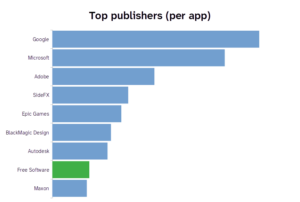
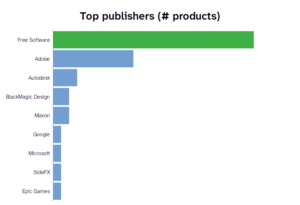
The use of software under free licenses already seems to be relatively widespread, accounting for between 26.5% and 43.5% of all productions, depending on how it is calculated; however, it remains mainly confined to secondary applications and numerous but small tools. In number of products, free software as a whole is much more numerous than proprietary software, but taken individually, each of these products is much less used than the large applications of the main software publishers in use in the field: Google, Microsoft, Adobe, SideFX, Epic Games, BlackMagic Design, Autodesk and Maxon.
It is also clear that the most widely used free software are also the largest and most complete or complex applications (Blender, LibreOffice and OpenOffice, Krita, etc.). It should also be noted that some “small” free tools are in fact software blocks reused by other applications, including proprietary software (FFmpeg, OpenSSL, OpenEXR, OpenImageIO, etc.) and that in this sense, free software also forms a fundamental and indispensable foundation, although not mentioned in our survey. A substantial part of the use of free or open-source tools consists of extensions (plugins, add-ons, scripts, etc.) for proprietary software that nevertheless offer a programming interface.
The case of Blender is exceptional, and in the current results of the survey, it is at the top of the list, all uses combined; this would probably not be the case if the survey was limited to animation or VFX studios, which work very predominantly with Autodesk Maya, but it extends to other fields and freelancers. In any case, even if companies mainly use other software, the fact that it is free and easy to install means that Blender is still present in many companies without being the flagship software for production.
Qualitative evaluation of the choice of software
Beyond this state of affairs, we have been more qualitatively interested in how users choose their software and the reasons that may lead to the adoption of free software.
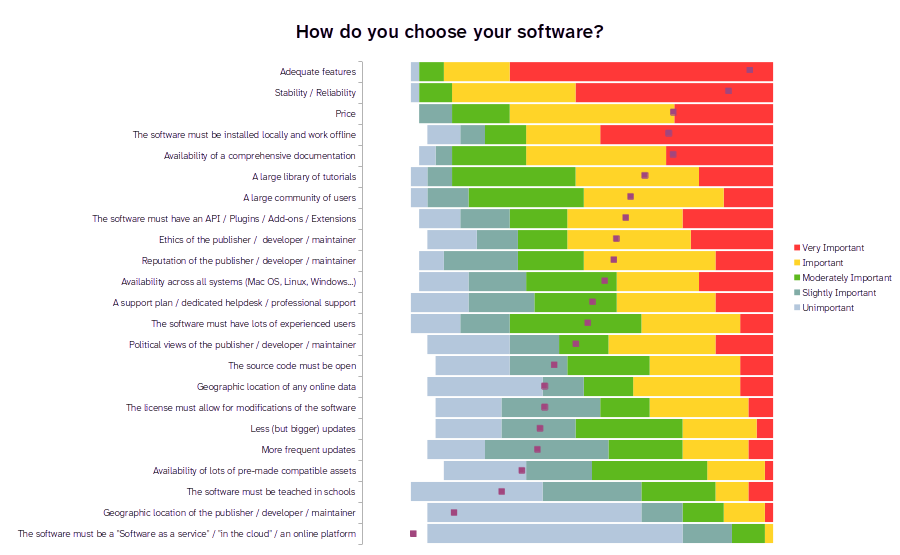
Two criteria stand out clearly in the choice of tools, not surprisingly: the adequacy of the functionalities with the needs and the reliability. The other most important criteria are, in order: the price, the ability to run the application locally (whether or not it is a SaaS, Software as a Service), and the availability of comprehensive documentation.
On the contrary, and logically, it is preferable that the application is not remote, in the “cloud”. Other criteria are perceived as being particularly unimportant, such as the geographical location of the developer or publisher, or whether the software is taught in schools. This last point seems to contradict the fact that the availability of people with software experience is a distinctly more important criterion. The association points out that the openness of the source code and the possibility of modifying the tools are notably unimportant criteria in the choice of the applications, in contradiction with the expressed need for functionality and reliability.
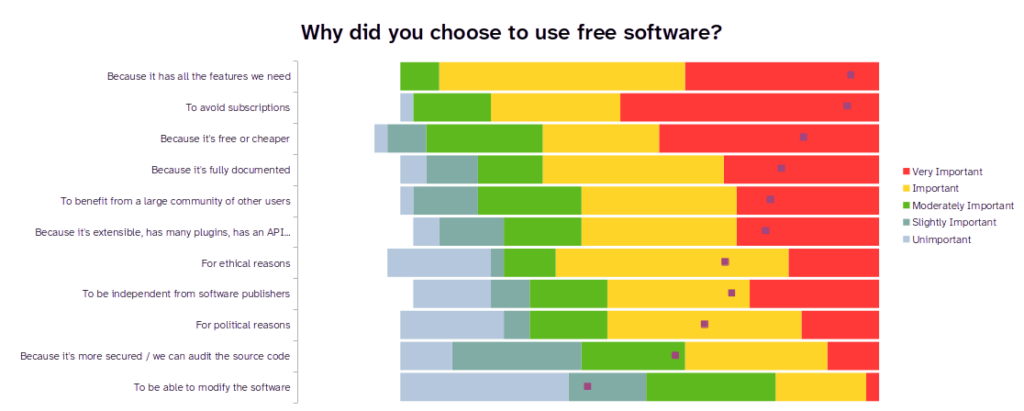
On the free software side, the main criteria for its adoption are, of course, the functionalities available, but also: the absence of a subscription or rental, the price, the availability of the documentation, the existence of a large community of users, and the extensibility, the possibility of adding plugins. Ethics and independence are also strong criteria.
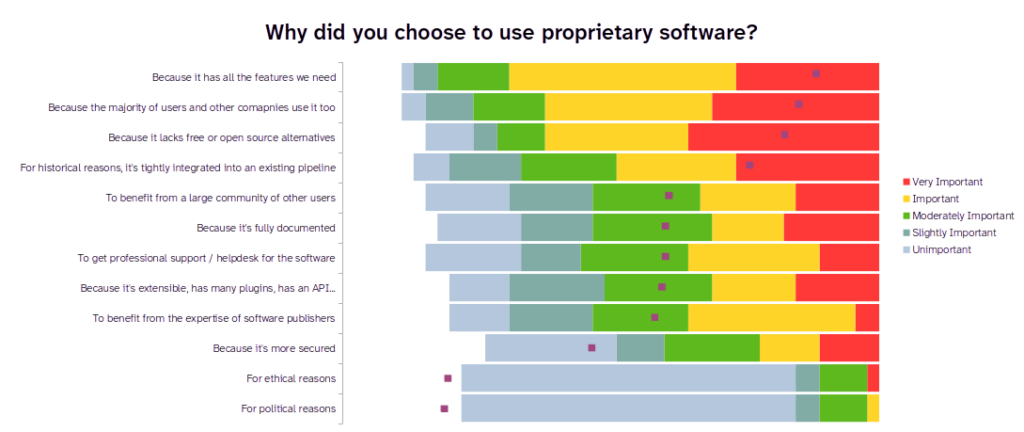
In the case of proprietary software, few criteria are perceived as particularly important, except for four: the available functionalities, the fact that the software is already widely used by a very large number, the lack of open-source or free alternatives, or for some historical reasons, the software being already integrated into a production chain. It is noteworthy that three of these four reasons are more about coercion than about free choice.
Level of satisfaction
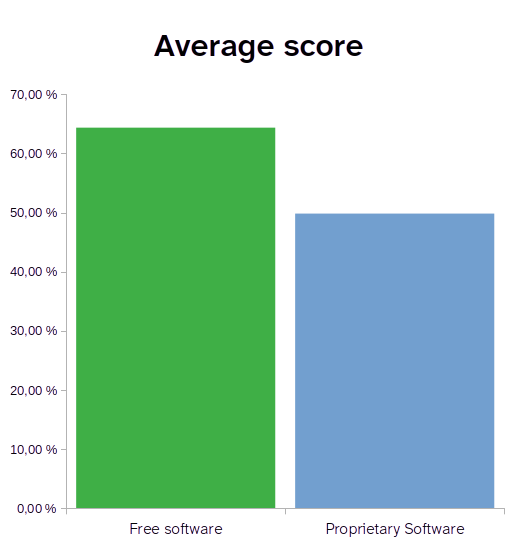
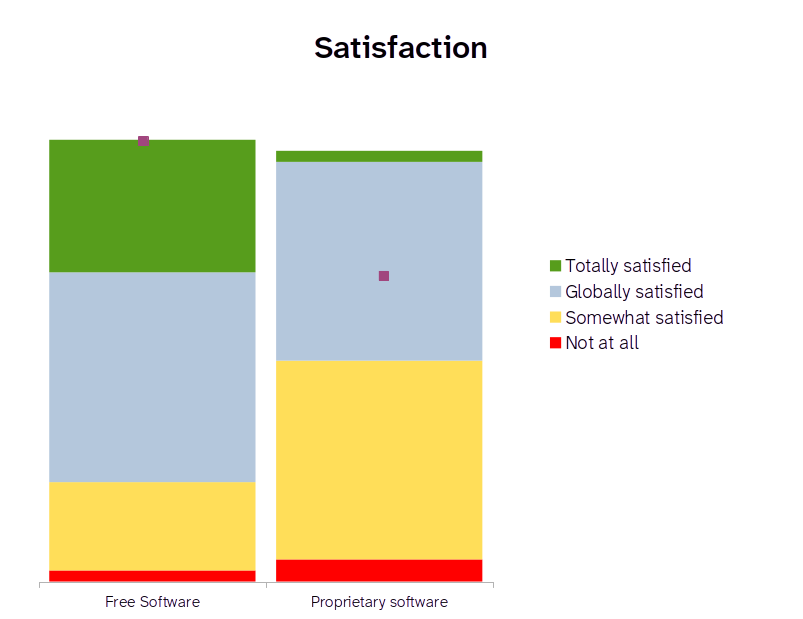
The level of satisfaction with the use of free and proprietary software is clearly different: 14.6% of users of free software are totally satisfied, compared with only 1.75% for proprietary software. On a scale ranging from “not at all satisfied” (0%) to “totally satisfied” (100%), the score for free software is 68.3% while that for proprietary software is 48.7%.
The relative dissatisfaction with the use of proprietary software seems to be largely related to the feeling of powerlessness and alienation of users (comments received through the open questions even indicate intense frustration). In this sense, it is quite relevant to support the emancipatory approach of the adoption of free software, while keeping in mind that the main reason for the choice of software lies in the quality of the available functionalities and their price.
Development
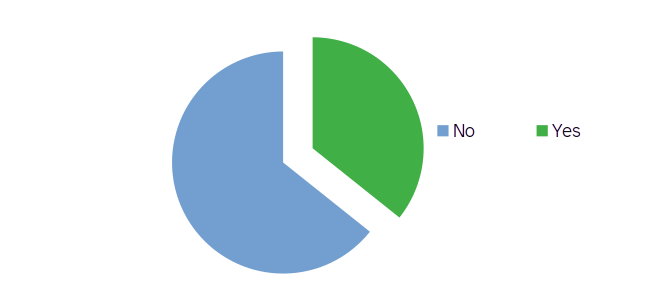
We have also looked at the software development in companies. 31.1% of respondents say they develop their own tools, whether simple scripts or complex applications. The small number of respondents does not allow reliable conclusions to be drawn on this subject, but we can still note that only 35.7% of them report making their tools available under a free licence, the rest keeping them private for internal use.
Environment and use of free software
A first part of the survey is aimed at quantifying the relationship between free and proprietary software, to give an overview of the current state of affairs.
Operating system
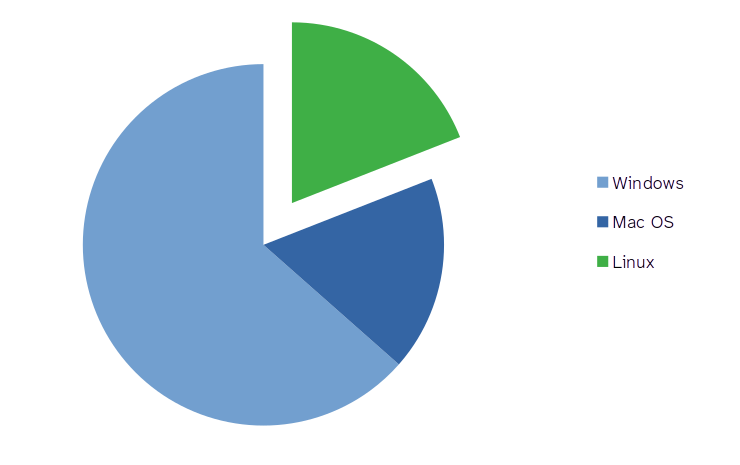
Microsoft Windows is undoubtedly the most widely used operating system in audiovisual production, accounting for 63.4% of uses, followed by Linux (the free system) with 19% of uses and finally Mac OS with 17.4%.
In the survey, we gave respondents the option of selecting several systems: 11.1% of respondents use both Windows and Mac OS, and 13.3% of respondents use both Windows and Linux. Those using either Mac OS or Linux or all three systems account for less than 5% of usage.
Thus, Windows is present in 88.9% of the respondents, Linux in 26.7% and Mac OS in 24.4% of them.
Share of free software
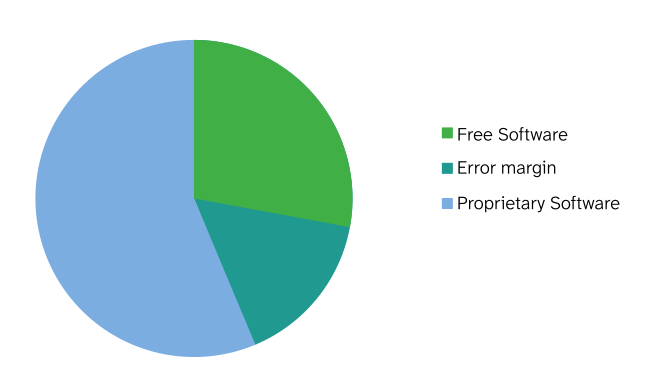
Based on the list of software used, the share of free software is 27.7% (excluding the operating system). However, when respondents were asked to rate their use and the importance of free software in their production, this share reached 43.3% of uses on average. This wide range shows a use of at least a quarter and possibly a third of the tools useful for production, and confirms the importance of the free licenses already in use today. This survey will be repeated at regular intervals in the future to allow us to monitor the evolution of this ratio.
We have drawn up a near-exhaustive list of applications used in audiovisual production (confirmed by an additional free-response field on the questionnaire, allowing respondents to add new applications). Blender tops the list of applications used, followed by the Adobe Creative Cloud suite (which includes Photoshop, After Effects, Premiere Pro, etc.) and administration tools (Google Docs, LibreOffice and Microsoft Office).
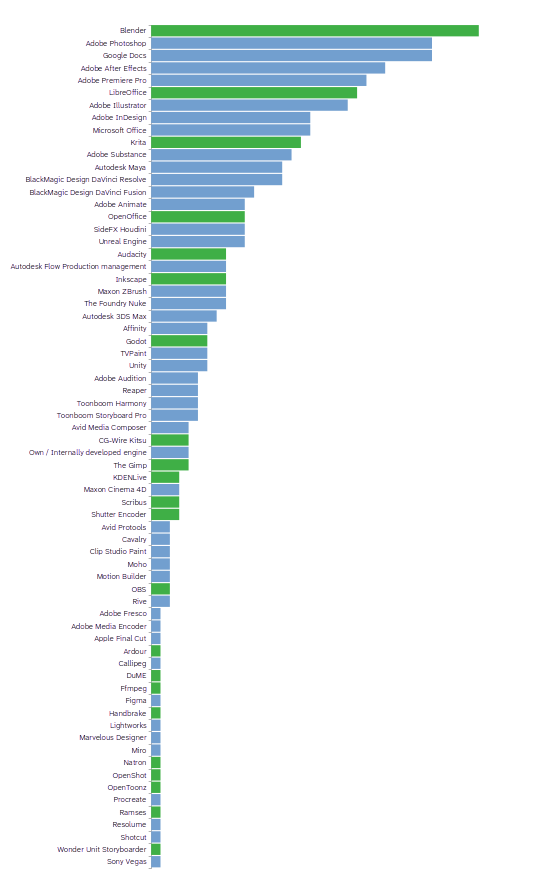
It is clear that the most widely used free software are also the largest and most complete or complex applications (Blender, LibreOffice and OpenOffice, Krita…). It should also be noted that some “small” free tools are in fact software blocks reused by other applications, including proprietary software (FFmpeg, OpenSSL, OpenEXR, OpenImageIO, etc.) and that in this sense, free software also forms a fundamental and indispensable foundation, although not mentioned in our survey.
The case of Blender is exceptional, and in the current results of the survey, it is at the top of the list, all uses combined; this would probably not be the case if the survey was limited to animation or VFX studios, which work very predominantly with Autodesk Maya, but it extends to other fields and freelancers. In any case, even if companies mainly use other software, the fact that it is free and easy to install means that Blender is still present in many companies without being the flagship software for production.
Other points of comparison are worth making:
- In the realm of real-time and interactive rendering engines, the free Godot engine is on a par with Unity, though still far behind Unreal Engine.
- In terms of office applications, LibreOffice and OpenOffice combined surpass the leader Google Docs, though with a slightly different usage (Google Docs allows real-time collaborative use as opposed to LibreOffice or OpenOffice offline applications), and their usage seems to be complementary rather than competitive. Anyway, despite its entrism and strong lobbying, Microsoft Office is lagging behind.
- In 2D image creation, the free applications Krita and Inkscape are outperforming Affinity, but still about half the use of the equivalent apps in the Adobe suite (Photoshop and Illustrator).
- For production tracking and asset management, Kitsu accounts for about half of Autodesk Flow Production management uses.
- Video editing and 2D animation are very largely the result of proprietary applications (Adobe Premiere Pro, Adobe After Effects, DaVinci Resolve and Fusion, Adobe Animate, TVPaint) and the use of free software is very minor, although some alternatives, relatively limited, exist (Krita and OpenToonz for animation, KDENLive and OpenShot for editing).
- In the niche of video encoding and real-time stream processing, free software is numerous and predominant; this is the only area where the supply of free applications (OBS, Handbrake, Shutter Encoder, DuME…) exceeds the proprietary supply; it is noteworthy that all these applications rely on FFmpeg, the fundamental building block of multimedia stream processing.
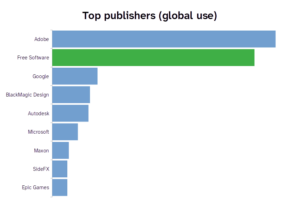
In total, therefore, free software accounts for 27.7% of applications, but it is interesting to classify the application publishers in comparison with free software as a whole, considering them as a means of emancipation from the publishers in question. The balance of power and privatization, the control of the means of production, is then clearly shown, and shows that the tools are not the result of independent, ethical, social or solidarity companies… And that free software must continue its progress.
The relatively large share of the overall use of free software therefore seems to be explained mainly by the large number and diversity of tools on offer. However, the strength of the usual large publishers of widely used applications, Adobe, Google, Microsoft, is noticeable, ahead of more specialized publishers such as SideFX, BlackMagic, Maxon or Epic Games. Autodesk is a special case, a publisher for whom the audiovisual sector is relatively minor in its catalogue.
Few large free applications can match their proprietary counterparts, apart from Blender, LibreOffice and to a lesser extent Krita, but small free tools are widespread and numerous.
We assume that this is largely due to financial considerations or to the number of contributions, the limits of which in the field free software favour the smallest projects which can be maintained by a small number of people. The financing of free software appears to be a key point in the development of alternatives to proprietary tools, but we can see a real and measurable interest in free software on the part of users, and the existence of a large community of developers ready to meet this demand.
However, it is important to note that even when credible and professional alternatives exist, such as KDENLive for video editing for example, they may be underused, and we also assume a lack of communication and popular education around these topics.
Choice of the tools, choice of free licenses
Beyond the quantitative evaluation of the use of free software and the conclusions we can draw from it, we were interested in a qualitative way in how respondents choose their software, as well as in the criteria that may make them prefer free software or their level of satisfaction with this free software, compared to proprietary software.
Opinion on free software
In the open question “Share your opinion on free software“, several trends emerge.
I’d like to use more free software
Most of the comments are about wanting to break free from publishers, gain empowerment, and use as much free and open source software as possible.
[Avoid] being dependent on the software/licence
[Free software] really responds to a human philosophy that I find very relevant, [it gives] real means to humanity.
[Free] software seems to me to be more correct to use every day, generally I feel that the person or organization behind it is more attentive to the needs of the users.
I work on a small scale, and I often find the free software community more responsive to helping me than a large company.
[Free software] is a collective intelligence that can align with usages.
It’s a form of emancipation that I find essential.
However, respondents mention a number of obstacles to the adoption of free software.
I don’t necessarily have the time or energy to learn new software and change my working methods.
It’s hard to collaborate (to be employable) when everyone is using the same non-free software.
I always have trouble finding the news, the alternatives, especially when it comes to professional software
In my company, I don’t choose the software I work on.
The notion of sharing knowledge and techniques also comes up very frequently. Finally, note the predominant mention of Blender, which was clearly praised by the majority of respondents, and let’s conclude with this particular comment:
Congratulations to all the contributors.
General criteria for the selection of software
Unsurprisingly, two criteria stand out: the functionality and stability of the application. Price, the fact that the application runs locally and is not an online service, and the availability of a comprehensive documentation and tutorials are the other most important criteria. Criteria that free software has no particular difficulty in meeting.
The least important criteria are the geographical origin of the publisher or developer, whether the software is taught in schools or the availability of ready-made items for reuse.
Back to the importance of software education in schools, although the survey respondents do not see this as an important criterion, the fact remains that the existence of a large community of users is a very important criterion, and that the availability of people with software experience is also of relatively high importance.
We see the importance of ethics and the reputation of developers, a criterion in favour of free software, while the openness of the code or the possibility of modifying software appears to be very secondary. It should be noted, however, that this is a view of the users, but that it is this openness that allows the development of more relevant and adequate functionalities as well as reliability, despite the lack of funding, through code control and free contributions, whereas functionalities and reliability are by far the two most important selection criteria. This gap highlights for us the need for popular education around the issues related to code and digital in general.
Criteria specific to free or proprietary software; comparison
Beyond the general choice, we are interested in the specific criteria applicable to free software that can drive its adoption.
Choosing free software
It is remarkable that almost everything that is specific to free software is considered important in the choice of software. Of course, there are the criteria of functionality and price, documentation and community, which come first, but also the importance of ethics and independence, and to a lesser extent political reasons.
Again, the openness of the code or the ability to modify the tool appears relatively secondary.
We asked participants some open-ended questions, and here’s a summary of the different responses.
General remarks
- Access to the possibility of creating quality content across borders, reducing economic and financial gaps between people.
What is frustrating or limiting in your use of free software?
- Learning difficulties (lack of tutorials (and a community) at a professional level, due to either non-existent or too complex documentation…)
- Difficulty in changing habits or those of colleagues.
- Lack of free alternatives, or hard to find/unknown alternatives.
- Lack of functionality, or degraded user interface/experience compared to equivalent proprietary software.
What do you enjoy about your free software?
- Free and no subscription.
- Applications often similar to private alternatives.
- The enthusiasm and innovation, the confidence around certain applications (especially Blender).
- Software that may be better than their proprietary alternatives (especially Blender, Krita, Storyboarder) in terms of functionality or interface.
- The ability to test easily, at no cost.
- The availability of communities, tutorials, mutual aid, the notion of sharing.
- The feeling of participating in another idea of society.
- Independence, especially from large companies, and ethics.
Some users even talk about love for the software, in the case of Blender!
Choosing proprietary software
Leaving aside the overriding importance of application functionality (a criterion which is also valid for free software), it is quite remarkable that the important criteria in the choice of proprietary software actually reveal a non-choice, a decision taken out of constraint: because the tool is already widely used everywhere, for lack of an alternative, or for a reason of historical use.
The other criteria applied to proprietary software are significantly less important, including when compared to the criteria associated with free software. It is also noteworthy that, unlike free software, ethics is a non-choice criterion.
We asked participants some open-ended questions, and here’s a summary of the different responses.
General remarks
- Inertia and habits are an obstacle to change, proprietary software is very well established throughout the professional world.
- Lack of free alternatives (especially to Adobe After Effects).
- Perceived lack of compatibility between free software and production pipelines with proprietary software.
What is frustrating or limiting in your use of proprietary software?
- Subscriptions.
- The dependence and lack of listening of publishers.
- The lack of innovation.
- Restrictive terms of use (licenses).
- The rapid obsolescence with the updates.
- The introduction of AI tools.
- The fact of having to be connected to the internet / online software.
- A feeling of being ripped off.
- The publishers’ lack of ethics.
- The lack of reliability, especially in relation to price or subscription.
What do you enjoy about your proprietary software?
- Habits.
- Large community of users, standard software in production.
- The complementarity of the software of the same suite.
- The versatility of the applications.
It is clear from all the testimonies received that users are extremely frustrated with their proprietary software, even when they acknowledge its performance and usefulness. This frustration seems to stem mainly from a strong feeling of powerlessness and dispossession of their means of production.
Overall, free software seems to enjoy a much better image among the respondents to the survey, which is confirmed by asking them about their satisfaction.
Comparison of satisfaction
Whether the selection criteria in the previous section are translated into an average score, or the satisfaction levels of the survey respondents are averaged, satisfaction with free software is around 66% (± 2%) while that with proprietary software is 49.2% (± 0.6%). The difference is unambiguous.
Specific case of extensions
As can be seen from the software selection criteria, in the audiovisual field, software extensibility is important; the use of plugins, add-ons, scripts, is very widespread.
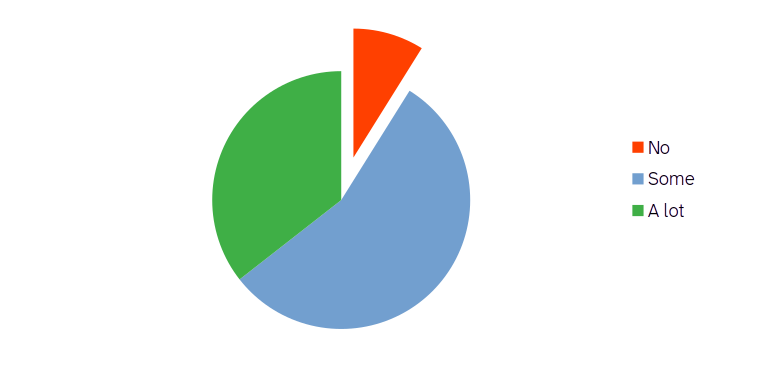
91.1% of respondents use extensions for their applications, 35.6% of them say they use them “a lot”.
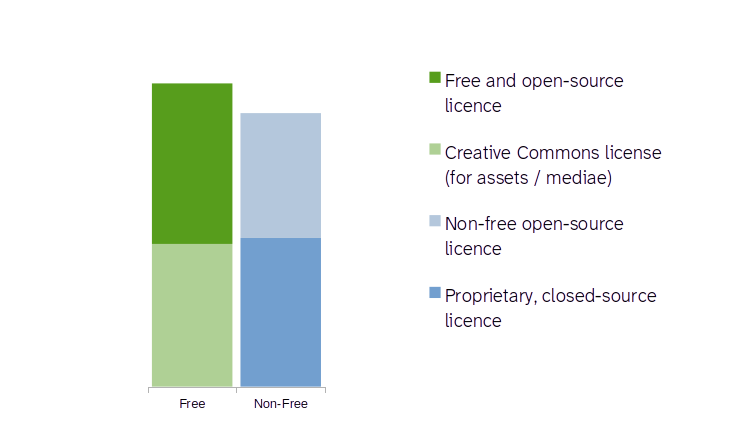
We looked at the specific case of these extensions and their licenses, including graphic, animated or audio elements under open licenses such as Creative Commons licenses.
In this specific field, the use of free or Creative Commons licenses is the majority; and among the proprietary licenses, almost half are still open source. This can be explained on the one hand by the fact that the languages used are scripting languages without compilation (Python, ECMAScript1 standard, or PHP, see Development section) for which it is more complex to hide the source code, but joins the fact that most of the free software used are smaller projects than large complex applications.
Development
It is common in the audiovisual field for companies (or even freelancers) to develop their own tools, as we can see from the survey where 31.1% of respondents say they develop their own tools.
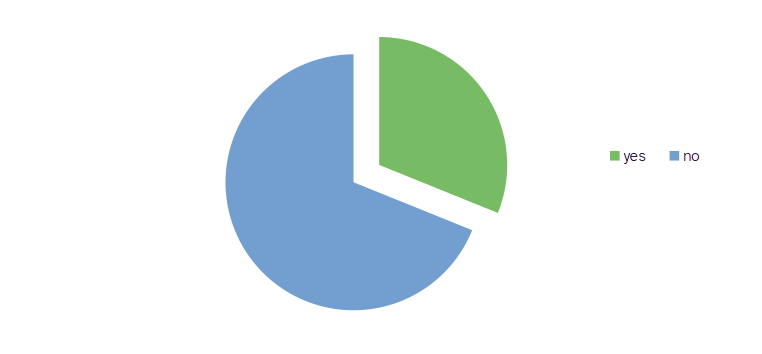
However, the small number of responses to the survey does not yet allow us to draw clear trends on this particular point; we simply note that those distributing the result of their development under a free licence remain in the minority; not because they do so under other licences, but because they prefer to keep their tools in-house, private, without distributing them.
Methodology and sample
This survey was conducted using an anonymous online questionnaire, opened on 31 March 2026, and still accessible. The sample consists of voluntary contributions from professionals or students in the broadest sense of the audiovisual field (shooting, animation, special effects, sound, music, real time and video games)2 recruited through social networks3.
In order to check the representativeness of the sample, several questions are designed to establish its profile, the results of which are presented below.
The questionnaire is written in English, but it is specified that the open answers can also be written in French.
The full questionnaire is available here.
Description of the sample
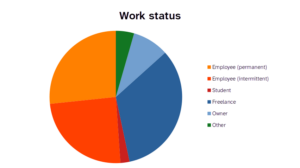
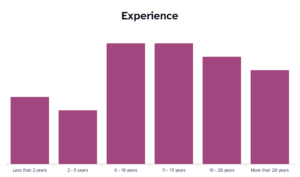
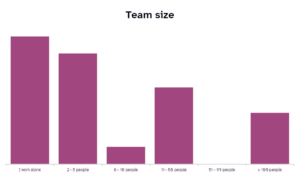
Despite the random nature of the recruitment of respondents, our sample is diverse and appears to be balanced, although we cannot be sure that it is representative. We note an over-representation of respondents working alone, and large variations in team sizes, but this may be related to the actual distribution of company sizes in the field.
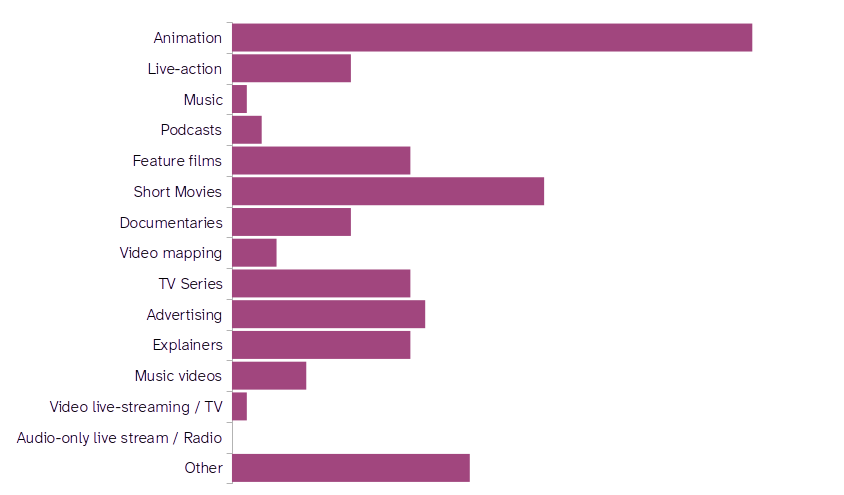
The sample shows a clear over-representation of the field of animation, and a lack in the field of sound, radio and music.
Attitude towards free software
As the survey is conducted by an association working for the promotion of free software, there is a real risk of bias in the sample in favour of free licenses. We therefore asked the respondents for their views on the subject.
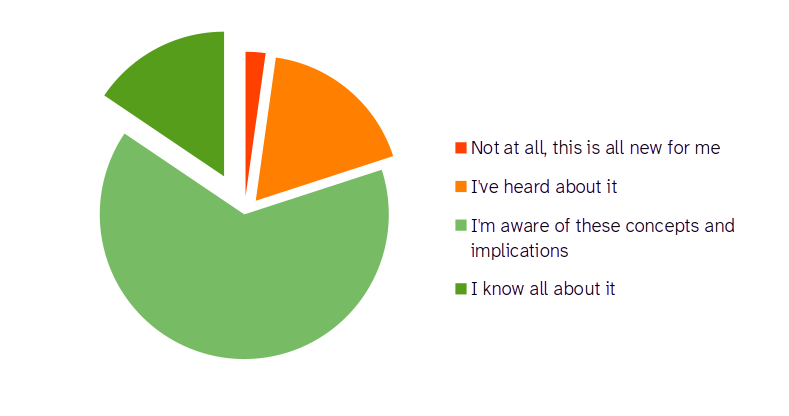
While the vast majority of respondents are familiar with the concept of free software, a minority really understands all the ins and outs, and the sample also includes people who have simply heard of it or for whom the concept is completely new.
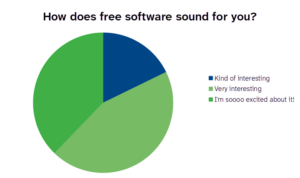
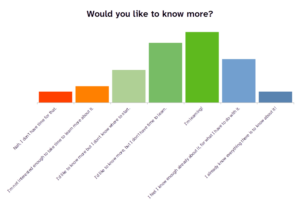
After a brief introduction explaining the principle of free software on the questionnaire, respondents express a strong interest in free software. No one said they were not interested at all, although some expressed no desire to learn more.
While the sample probably reflects a bias in favour of free software, we are confident that it is nonetheless sufficiently diverse to give a reliable representation of the state of the use of free software in the audiovisual field.
Software
This work did not take advantage of any use of any artificial intelligence, whether for the collection, analysis or presentation of data, or the writing of this article.
We’ve even made a commitment to only use free software:
Discussion
This survey has been available online since March 31, 2026, but we note the difficulty of recruiting enough participants; although large trends are evident in the results, the low number of respondents does not allow for in-depth coverage of some topics, as well as the bias towards free software of respondents resulting from the difficulty of recruiting beyond our social circle.
It seems to us important to maintain access to the questionnaire to continue to refine the results; it will also be interesting to monitor the evolution of these questions over time, and thus to renew the survey regularly.
A future version of the questionnaire may also collect the geographical origins of the respondents in order to ensure this diversity in profiles.
With a larger number of participants, we could take the analysis further, cross-checking a number of data, for example the size of the teams or the types of production and the attitude towards free software or the criteria for choosing software.
- ECMAScript is a standard implemented in various languages such as JavaScript, ExtendScript (Adobe), ActionScript (Adobe), etc. ↩︎
- When recruiting via social networks, we have always been very clear about the broad sense in our use of the term ‘audiovisual’. ↩︎
- LinkedIn, Facebook, Discord, Mastodon, Bluesky and also our chat server called Zulip. ↩︎